
Wisdom Through Wood: Mistakes are the Teacher
The name Wisdom Through Wood was intended to be a reminder of the lessons learnt through a practice. Alex Jerrim, the founder of Wisdom Through Wood and a dedicated life-long woodworker, noticed that it was often just at that time when his confidence in a task was high something would go ‘wrong’ and bring him back to a place of learning. A humbling experience which we can all relate to. He saw these mistakes not as a failure, but a reminder to remain present and aware rather than being carried away with a different train of thought. We live in a culture that usually treats mistakes as personal failures. Many of us learned at school that getting something “wrong” brings poor marks, embarrassment, shaming, or punishment. Consequently our perception of the consequences of making a mistake often inhibits our desire to risk trying something new, where the outcome is unknown.
At Wisdom Through Wood we encourage a different view: mistakes aren’t detours from learning; they are the path itself. The name was chosen for this reason. A slip of the knife, a catch on the lathe, or a misread grain line can be a remarkable teacher—if we meet it with attention rather than shame. The workshop becomes a place where curiosity replaces perfectionism, and where every misstep carries information.
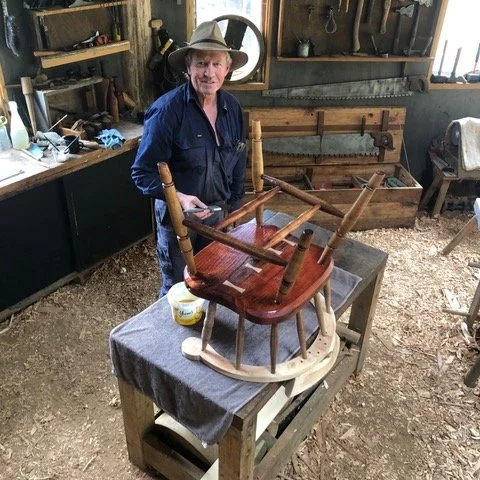
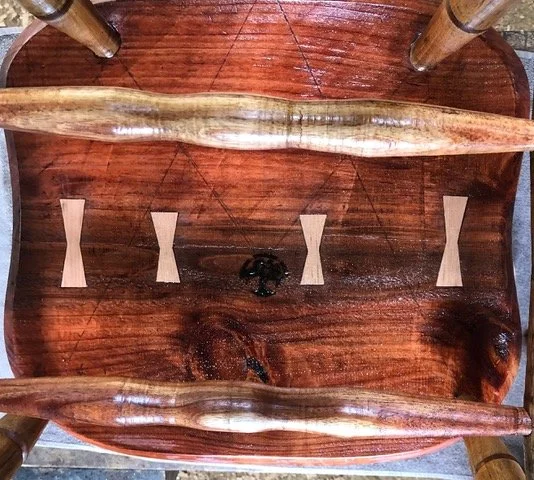
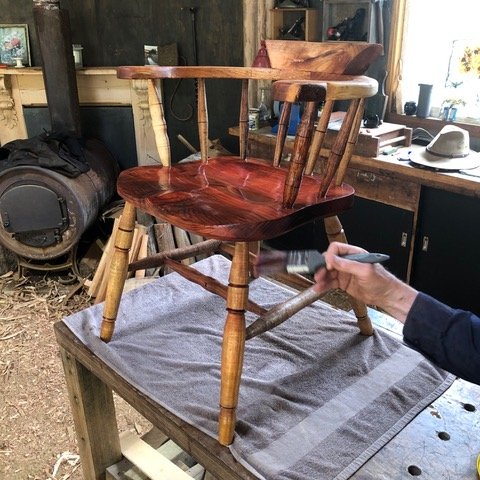
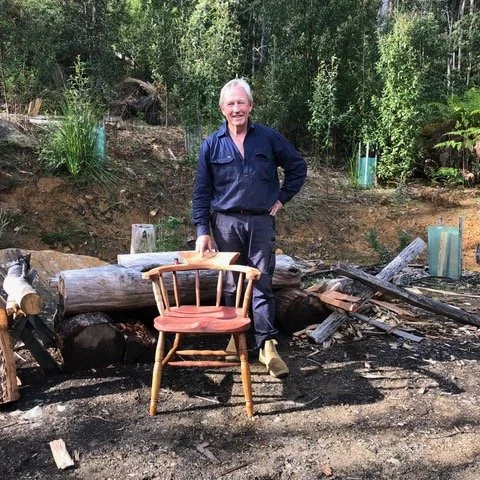
Here is a sequence of pictures showing Mark’s chair. He accidentally split the seat almost in two when dis-assembling the chair after a dry fit. We were able to glue the seat back together and stabilise the break with a series of butterfly (or bow tie) inlays. What seemed like a complete disaster in the moment gave us the opportunity to discuss a couple of options and then recover the seat and finish off the chair. Great learning not just about using butterfly inlays but also about the limits of particular timbers and what we ask them to do. (And the limits of how much gusto we bring to a piece of wood with a heavy hammer.)
Unlearning the shame of error
When you pick up a woodworking tool for the first time after watching someone with years of experience demonstrate the tool, it’s easy to think that your attempts must be perfect. But skills grow through small, steady adjustments—angle, pressure, stance, rhythm which have to be practiced and felt in your body. The only way to make adjustments is to notice when things aren’t going well. A rough cut shows where the grain truly runs. Each moment that doesn’t go to plan is a message about cause and effect, not a verdict on your ability.
This is why we speak of iteration rather than perfection. The first attempt is for learning; the second for refinement; by the third, the work begins to sing. What changes is not just your technique but your relationship to risk. Once you’ve survived a catch or repaired a break, worrying about mistakes loosens its grip. You become less fragile and more curious, willing to explore and to listen closely to what the wood is telling you.
A supportive, safe atmosphere for learning
None of this happens by accident. On every Wisdom Through Wood course, our intention is to create a supportive, safe atmosphere where learning can flourish. That means clear demonstrations, paced instruction, and an atmosphere where conversation flows easily. It means normalising questions, naming what happened without judgment, and taking a breath before deciding on the next step. When something goes wrong—and it will—we slow down together, diagnose the cause, and choose a response. Sometimes that’s a strop to restore a keen edge. Sometimes it’s a change of stance or a gentler, slicing cut. Sometimes it’s a visible repair that becomes part of the object’s story.
Safety is both physical and emotional. We teach you to make cuts you can control, to work with the grain rather than against it, and to recognise when a tool needs attention. Just as importantly, we protect the fragile early stages of learning: no shaming or embarrassing. The bench becomes a place where it’s acceptable to show a “learning piece” and say, “Here’s what happened, and here’s what I tried next.”
What mistakes actually teach
In time, we begin to recognise the patterns. Tear-out in a spoon bowl invites you to reverse direction and lighten the cut. A wandering saw line teaches you to start with a shallow track and let the saw do the work. A loose joint becomes a lesson in creeping up on a fit rather than forcing it. These aren’t abstract rules; they’re embodied memories that stick precisely because you felt them. The lesson enters your hands as much as your head.
And when a repair is needed, it becomes an act of care. A neat patch, an extra facet, a re-turned surface: these choices add character and longevity. The finished object holds the history of your learning. It’s not a record of flawless execution; it’s evidence of attention, adaptation, and persistence.
Perhaps the most encouraging moment comes when someone else uses what you’ve made. A friend stirs soup with your spoon. A family member sits on your stool. The object becomes a witness to your effort—a tangible reminder that time spent in practice is time well spent. Unlike digital tasks that vanish when the screen closes, a handmade piece remains, quietly testifying to the skills you built along the way. Most commonly other people will never notice or question the parts that you might have thought of as a mistake.
Learning as community
In small groups, you see how different hands solve similar problems. You hear another person describe the same challenge in their words and notice an approach you hadn’t considered. Sharing a meal, pausing to admire a neighbour’s progress, and talking through a tricky moment widens your understanding. The workshop becomes a community of practice where error isn’t hidden but welcomed as a shared resource: “Good—now we can learn from it.”
The heart of Wisdom Through Wood
Our courses are designed to replace fear with curiosity. We move at a human pace, outdoors whenever we can, with an emphasis on clear guidance, safe technique, and thoughtful reflection. We invite you to bring your imperfect firsts and leave with new skills, a tangible object full of story, and a healthier relationship to learning. Mistakes will happen—that’s the point. In meeting them well, you build judgment, confidence, and the kind of wisdom that only comes from doing.